
Varisu Web Services
At Varisu.in, we craft websites, applications, and digital experiences that drive growth and success.
At Varisu.in, we craft websites, applications, and digital experiences that drive growth and success.
At Varisu.in, we craft websites, applications, and digital experiences that drive growth and success.
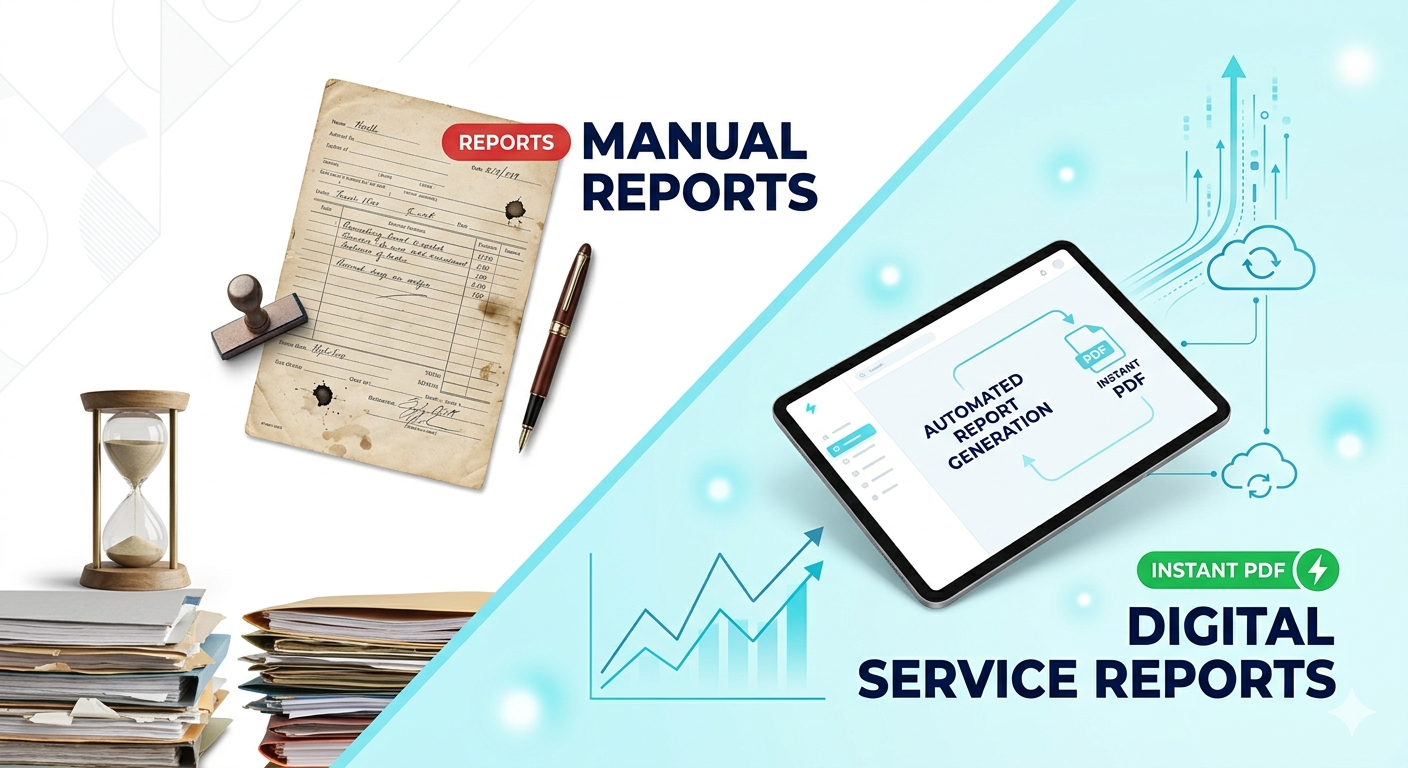
In today’s fast-paced corporate world, speed, accuracy, and scalability are the ultimate differentiators. Yet, many service-driven organizations are still held back by a traditional bottleneck: manual paperwork.
Service reports play a critical role in almost every service-based industry. Whether it is IT infrastructure support, corporate power solutions, field equipment maintenance, or client management, service reports help in tracking ongoing work, documenting complex tasks, and maintaining error-free records.
Traditionally, these reports were created manually using paper logs, local Excel sheets, or basic templates. However, with the rise of modern digital systems and automated workflows, businesses are rapidly transitioning toward digital service reports to maximize operational efficiency.
In this deep dive, we will analyze the key differences between manual and digital service reports, evaluate their pros and cons, and explore why automation has become a necessity for modern businesses.
A manual service report relies on traditional, non-automated methods to document field and service-related activities. These are typically filled out by hand on printed sheets or entered row-by-row into offline software like Excel or Word, then saved locally or physically filed away.
High Margin of Error: Prone to typos, missing details, and illegible handwriting.
Storage & Management Bottlenecks: Managing large historical archives becomes extremely difficult over time.
Operational Delays: Real-time visibility is non-existent; reports take hours or days to reach managers.
Poor Accessibility: Documents cannot be instantly retrieved from a remote location.
Limited Scalability: As client requests grow, the manual workload doubles, slowing down business growth.
A digital service report is a software-driven, automated document generated seamlessly through integrated digital workflows. Instead of manually drafting a sheet, data is captured directly via smart forms or mobile applications, which the system automatically compiles into beautifully structured PDFs or interactive web dashboards.Big companies invest heavily in data analysts. But in 2026, AI tools offer the same level of insights to everyone.
| Feature | Manual Reports | Digital Service Reports |
| Turnaround Speed | Slow, multi-step process | Instantaneous |
| Data Accuracy | Highly prone to human error | Precise and validated |
| Storage & Security | Physical folders or local disks | Cloud-based, encrypted storage |
| Accessibility | Restricted to physical location | Anywhere, anytime access |
| Process Automation | Not available | Fully automated pipeline |
| Business Scalability | Poor and resource-intensive | Excellent and frictionless |
Embracing digital transformation makes your documentation faster, smarter, and incredibly reliable. Here is how automation drives value:
1. Eliminates Time Wastage: Reports are generated instantly in a standard layout, freeing up valuable hours.
2. Flawless Accuracy: Built-in form validations prevent incorrect data entries, math errors, or missed fields.
3. Superior Organization: No more lost papers. Every record is archived systematically in a structured digital database.
4. Rapid Client Communication: Reports can be automatically dispatched to clients via email or messaging apps the moment a job is completed.
5. Boosts Workforce Productivity: Engineers and technicians can focus on resolving technical issues rather than spending half their day on documentation.
6. Centralized Audit Trails: Effortlessly track a client’s entire service history, maintenance cycles, and agent performance from a single screen.
While the benefits are massive, transitioning to a digital system requires looking at a few practical factors:
1. Internet Connectivity: Advanced cloud syncing models usually require a stable connection, though modern apps now feature offline data-saving modes.
2. Upfront Setup: Custom development or system integration requires an initial investment of time and budget.
3. Onboarding & Training: Teams accustomed to paperwork need a brief learning curve to adapt to new digital interfaces.
4. System Maintenance: Relying on software means accounting for occasional updates, system minor glitches, or server downtimes.
Rapid, standardized documentation.
Transparent service tracking for end clients.
Seamless communication between field staff, managers, and stakeholders.
Professional, brand-aligned report designs that elevate your company’s image.
Input: A field engineer fills out a simple, pre-structured digital service form on their phone or tablet.
Process: The system validates and processes the submitted data variables instantly.
Generate: The backend engine automatically populates a professional, branded PDF layout.
Deliver: The finalized report is safely saved to the cloud database and simultaneously emailed directly to the client’s inbox.
Digital service reporting holds immense value across diverse sectors:
IT Infrastructure & Technical Support: Tracking system deployments, network downtime issues, and hardware resolutions.
Power Solutions & Maintenance: Streamlining routine checks for critical systems like corporate UPS rentals, inverters, and battery banks.
Field Engineering: Standardizing on-site logs for electrical, mechanical, and civil engineering teams.
Freelance & Agency Project Management: Delivering clean, verifiable milestone reports to remote clients.
The era of manual data tracking is coming to a close. The next generation of service reporting will leverage:
AI-Assisted Logging: Smart text summaries based on brief technician notes.
Voice-to-Report Conversions: Dictating hands-free logs directly on the field.
Unified Ecosystems: Deep integrations linking reports straight to CRM, accounting, and ERP tools.
Predictive Analytics: Using historical report trends to forecast equipment failures before they happen.
Driven by the need to eliminate repetitive manual overhead, I recently designed and developed an Auto PDF Service Report Generator.
Captures raw form inputs through a highly intuitive UI.
Processes data instantly without requiring manual formatting.
Automatically compiles clean, corporate-standard PDF service sheets.
Dramatically reduces turnaround times and transcription errors.
Building this project allowed me to dive deep into workflow automation and explore how tailor-made digital tools can optimize operational efficiency, streamline tracking, and help modern workflows scale cleanly.
Digital service reports are completely redefining operational workflows. Compared to outdated manual setups, automated systems are faster, more reliable, and highly scalable. As businesses look to maximize resource output and minimize administrative bottlenecks, adopting automated documentation is the smartest step forward. The future of business is automated.
Looking to automate your business documentation workflows or turn manual sheets into instant, professional PDFs? Let’s connect to discuss how custom web automation can streamline your operations!